The standard that keeps the people who work on your electrical system alive — and the data, labels, and maintenance your safety program depends on.
NFPA 70E is the Standard for Electrical Safety in the Workplace — the national playbook for protecting workers from shock, electrocution, arc flash, and arc blast. Where the electrical code (NFPA 70, the NEC) governs how systems are built, 70E governs how people work on them safely afterward.
OSHA doesn't publish its own arc flash tables; its electrical regulations set the legal duty, and NFPA 70E is the recognized standard for meeting it. When OSHA investigates an electrical injury, 70E is the measuring stick — which makes it, for practical purposes, the requirement.
The core of 70E is a hierarchy: establish an electrically safe work condition (de-energize, lock out, verify) whenever possible, and when energized work is truly justified, control it — with risk assessments, permits, qualified workers, boundaries, and PPE matched to the calculated hazard.
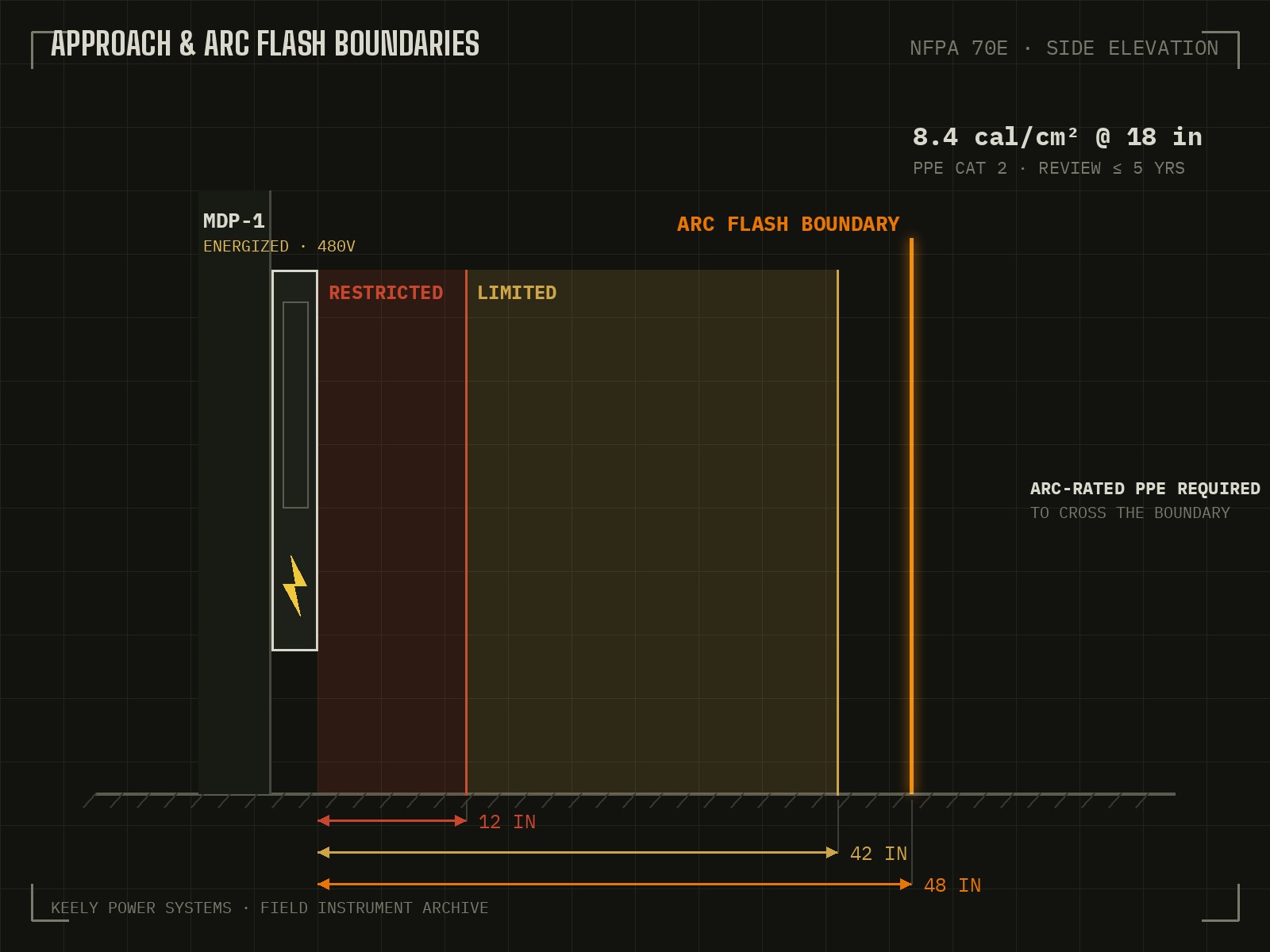
Arc flash risk assessments and incident energy analysis determine the danger at each piece of equipment — reviewed when the system changes and at least every five years. This is the arc flash study.
Gear that may be worked on energized must be field-marked with the hazard so a qualified worker — yours or a contractor's — can choose the right PPE and boundaries at a glance.
Only qualified persons may work where electrical hazards exist: trained on the hazards, the procedures, and the PPE, with retraining at intervals not exceeding three years.
70E requires the condition of maintenance to be considered. A neglected breaker clears slowly, and the real incident energy can exceed the label. Maintenance isn't adjacent to safety — it's inside it.
Missing arc flash labels, no risk assessment, untrained workers doing energized work: typically cited as serious violations at up to $16,550 each under the 2026 federal schedule — and each unlabeled panel or exposed employee can be counted separately.
Get cited again for the same or a substantially similar hazard and the classification most facilities call "willful" is actually repeated — but the distinction is cold comfort: the maximum jumps 10× to $165,514 per violation.
Willful means intentional disregard or plain indifference — up to $165,514 per violation (minimum $11,823), no prior citation required. An arc flash study or safety audit you received and ignored is exactly the paper trail that supports it. A willful violation involving a worker fatality can also bring criminal referral.
An arc flash injury brings an OSHA investigation measured against NFPA 70E, plus failure-to-abate penalties of up to $16,550 per day for anything left uncorrected — on top of workers' comp, litigation, and insurance fallout that dwarf the fines.
Your safety policies and training belong to you — but they stand on engineering data and equipment condition, and that's our lane. We perform the incident energy analyses and apply the labels your workers rely on, keep one-line diagrams current so lockout points are knowable, and run the maintenance program that keeps protective devices operating the way every calculation assumes.
The payoff compounds: a facility that pairs 70E's safe work practices with 70B's maintenance discipline has fewer energized surprises, lower incident energy at many locations, and documentation that answers auditors, insurers, and OSHA before they finish asking.
NFPA 70E itself is a consensus standard, not a statute — but OSHA's electrical safety regulations (29 CFR 1910 Subpart S) are law, and OSHA recognizes 70E as the way employers demonstrate compliance with them. In practice, an employer following 70E is following OSHA's expectations; an employer ignoring it is explaining why after an incident.
The documented program NFPA 70E requires employers to establish: how electrical hazards are identified, how shock and arc flash risk assessments are performed, what safe work procedures apply, who is qualified for what work, and how it's all audited. It's the umbrella over training, PPE, labels, and permits.
Equipment likely to be examined or worked on while energized must be field-marked with the arc flash hazard — typically the incident energy at working distance or the required PPE category, plus the arc flash boundary and system voltage. Those values come from an incident energy analysis, which is where our arc flash studies come in.
NFPA 70E requires retraining for qualified persons at intervals not to exceed three years — sooner when work practices, technology, or job duties change, or when an audit shows a worker isn't following the safety-related work practices.
Everything. The protection 70E promises — calculated incident energy, PPE categories, safe boundaries — assumes protective devices clear faults as designed. 70E explicitly requires the condition of maintenance to be considered in risk assessment. Unmaintained equipment can make every label in your facility optimistic, which is why 70E safety and 70B maintenance are two halves of one system.
For 2026, a first-time serious violation carries up to $16,550 per violation. A repeated violation — cited again for the same or substantially similar hazard — carries up to $165,514 per violation, the same maximum as a willful violation. Willful doesn't require a prior citation: knowing about a hazard (for example, from a study or audit you didn't act on) and leaving it uncorrected can qualify. Each affected panel or exposed employee can be cited as a separate violation, so totals escalate quickly.
Yes. Host employers share responsibility for hazards contractors face in their facility, and your equipment still needs accurate labels for anyone who opens it. If your own staff so much as resets breakers or swaps ballasts, some level of training and program coverage applies to them too.
Start with a no-cost, no-obligation survey: we'll walk your electrical system, give you a written proposal for your testing program, and include the replacement cost of your electrical distribution — so you know exactly what's at stake.