Loose connections and overloaded equipment run hot for months before they burn. Our certified thermographers find them on camera — while your facility keeps running.
Electricity flowing through a loose, corroded, or undersized connection meets resistance, and resistance makes heat. That heat cooks the connection further, resistance climbs, and the cycle accelerates until something chars, welds, or catches fire. From the outside of the panel, everything looks fine — right up until it isn't.
An infrared camera sees through that illusion. Scanning your panels, switchgear, transformers, disconnects, and motor control centers under normal load, we find components running hotter than they should and catch the failure cycle in its cheap, boring, early stage. Every anomaly is verified, photographed, severity-rated, and delivered in a report you can hand to your insurance carrier.
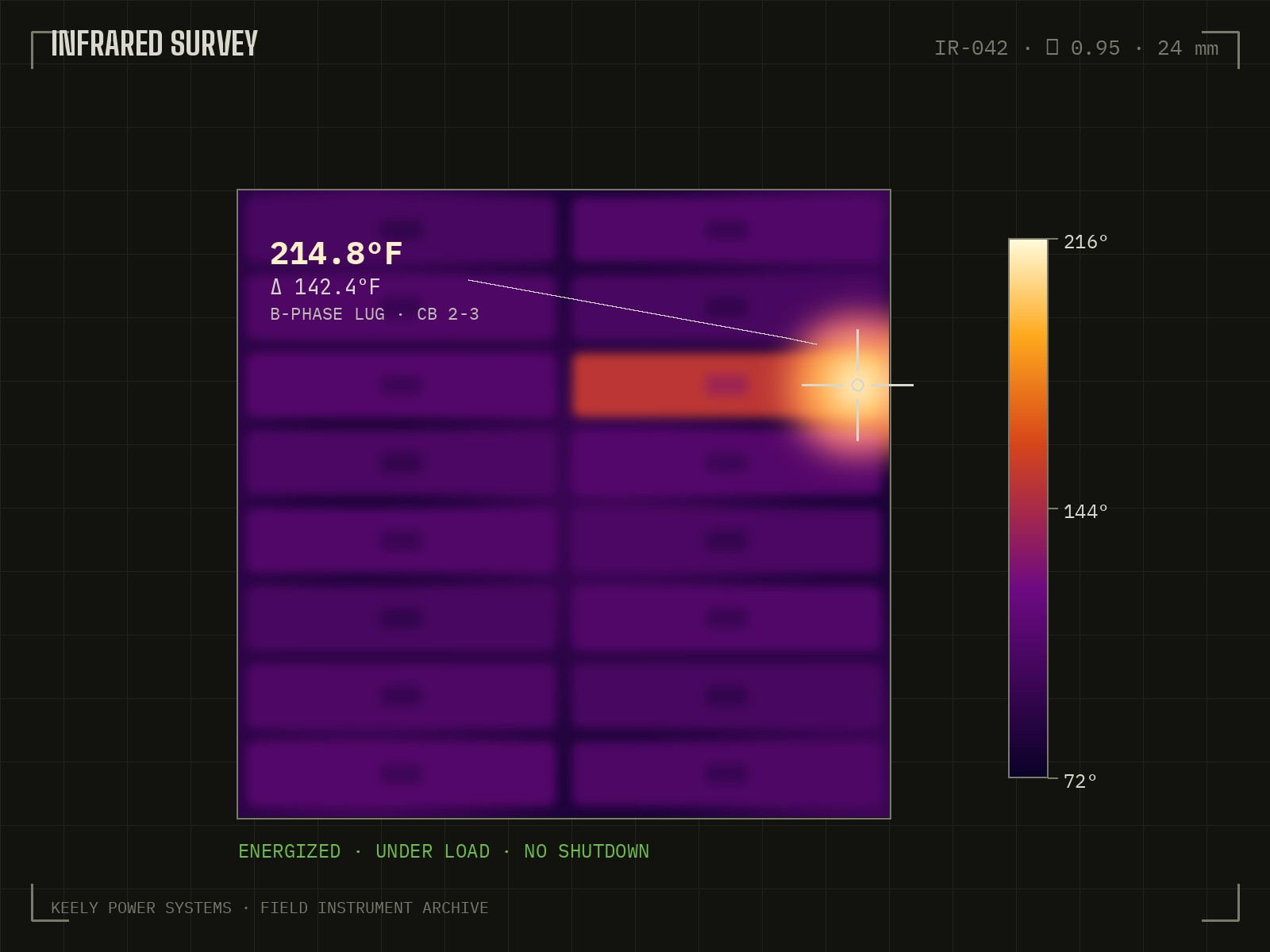
The #1 finding in almost every scan. A connection that's worked loose over years of thermal cycling shows up glowing on camera — and takes minutes to fix once found.
A conductor or breaker running near or past its rating carries its history in heat. We flag overloads and imbalance before they trip breakers or cook insulation.
Internal contact wear shows up as a breaker running hotter than its neighbors at the same load — a device quietly on its way to failing when you need it most.
Arcing inside enclosed gear may make sound before heat reaches the surface. That's why our surveys pair IR with ultrasound inspection on enclosed equipment.
We'll walk your facility at no cost and no obligation, then deliver a written proposal for your testing program — including the replacement cost of your electrical distribution system. One-time scans are welcome, and every scan can count as the first cycle of a full TEGG maintenance program.
Keely Power Systems is the testing & maintenance sister company of Keely Electric — the same local, licensed team behind 300+ five-star Google reviews across the state of Idaho.
No — the opposite. Infrared inspection works best with your equipment energized and under normal load, because we're looking for the heat that loose or failing components generate while working. Your facility keeps running the whole time.
Yes. Insurers increasingly require periodic infrared electrical inspections because they dramatically reduce fire claims. We provide a photo-documented report formatted to satisfy carrier requirements.
Annually is the most common baseline for commercial facilities, with more frequent scans for critical or heavily loaded equipment. As part of a TEGG program, the interval is set per-asset based on condition and criticality, consistent with NFPA 70B's condition-based approach.
Loose or corroded connections, overloaded circuits and phases, failing breakers, and unbalanced loads all show up as abnormal heat patterns. We verify each finding electrically before it goes in your report, so you're not chasing reflections.
Each finding is rated by severity, photographed in both visible light and infrared, and prioritized in your report. Critical items get flagged immediately — and repairs can be quoted and completed by our team, then re-scanned to confirm the fix.
Start with a no-cost, no-obligation survey: we'll walk your electrical system, give you a written proposal for your testing program, and include the replacement cost of your electrical distribution — so you know exactly what's at stake.