Ultrasound, partial discharge, de-energized testing, grounding verification, and full asset inventories — the deep diagnostics behind a serious maintenance program.
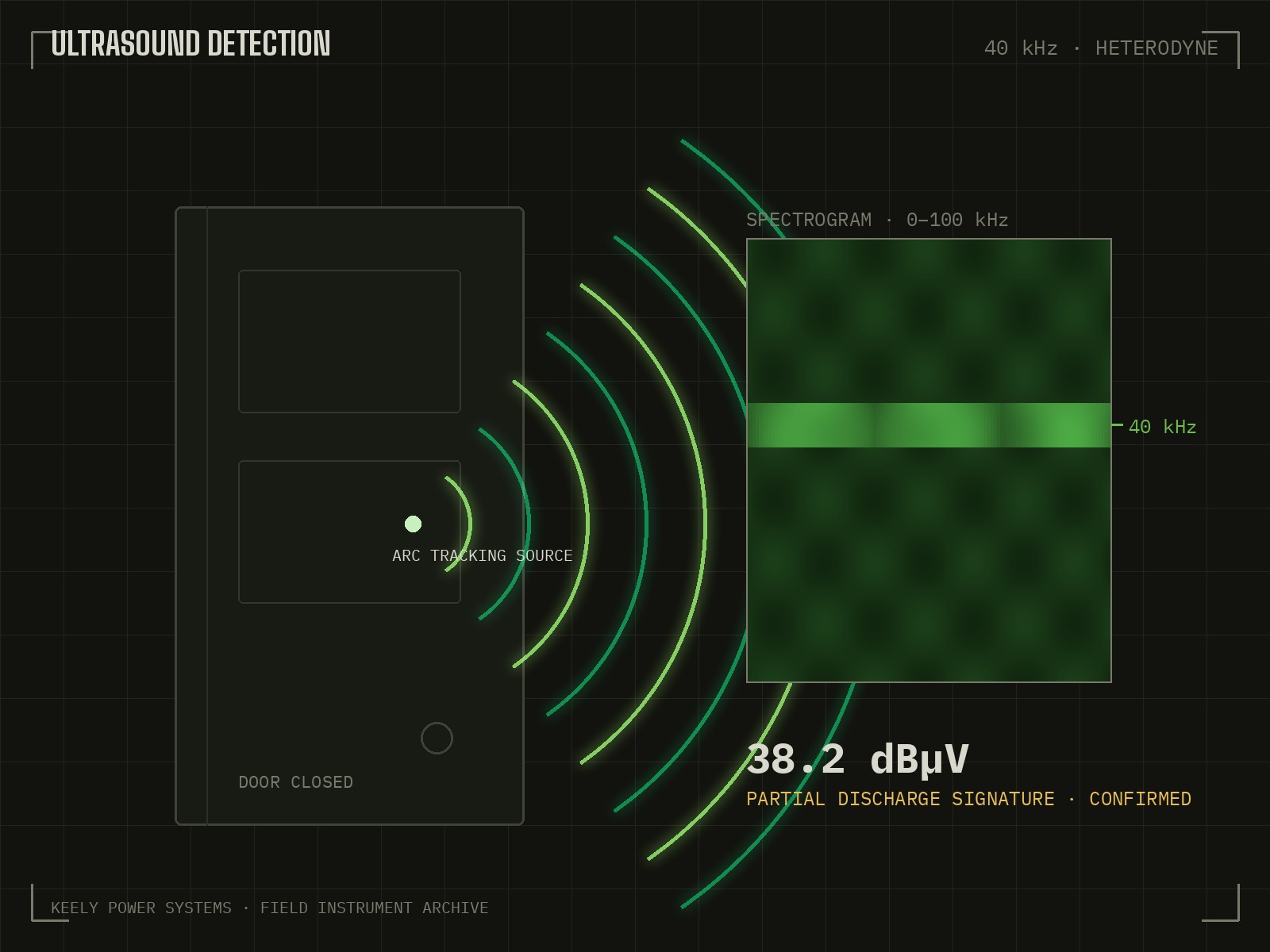
Some failures make noise before they make heat. Arcing, surface tracking, and corona discharge all emit high-frequency sound — inaudible to you, unmistakable to an ultrasonic instrument. Because sound travels through and around enclosures, ultrasound screening finds developing faults inside closed switchgear without opening a single cover.
Partial discharge — insulation breaking down microscopically under electrical stress — is the classic slow killer of medium-voltage gear. Caught early, it's a planned repair; caught late, it's a failed bus and a dark building. We screen for it as part of energized inspection rounds, pairing every ultrasound finding with infrared and electrical verification.
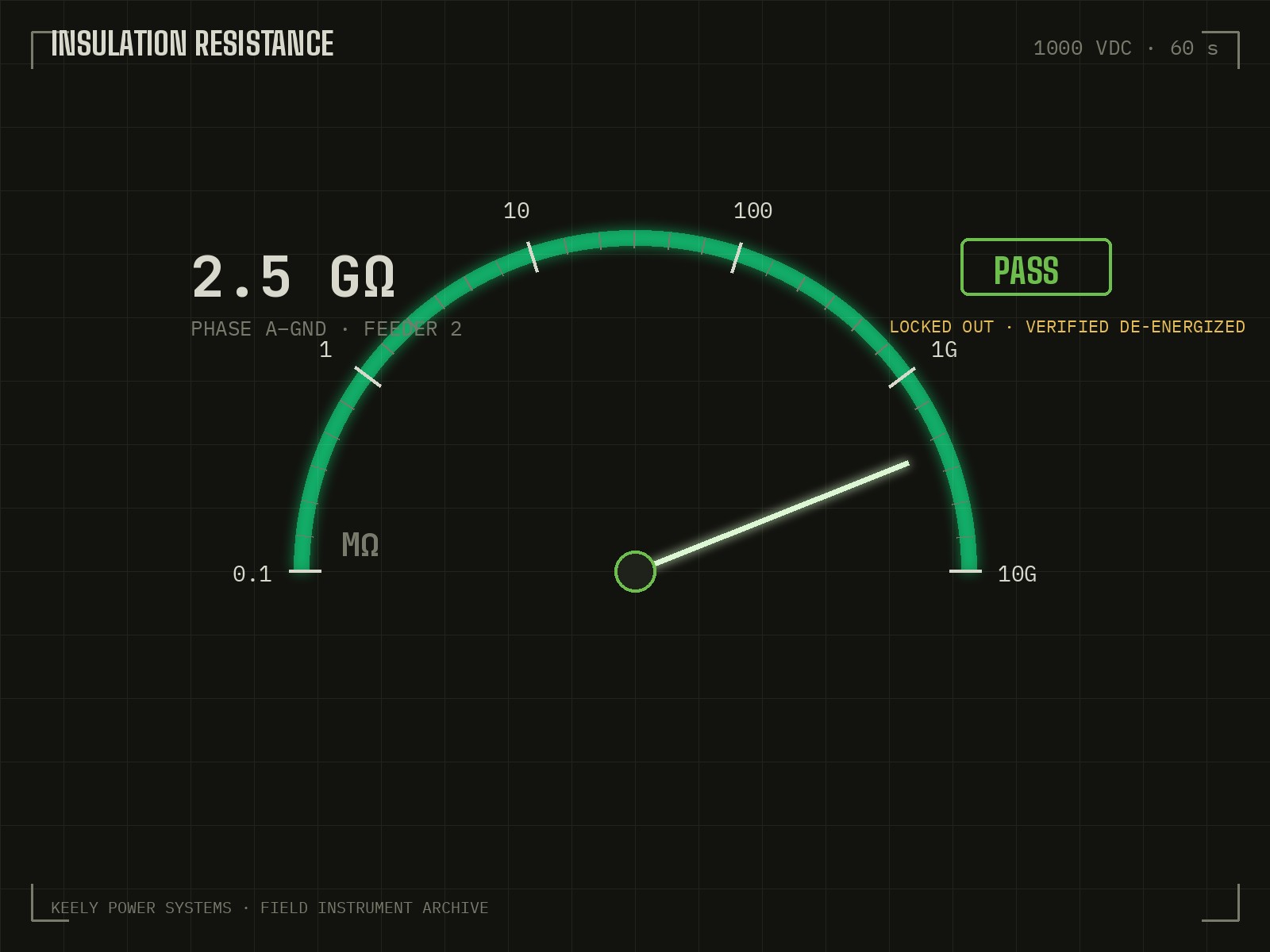
Some questions can only be answered with the power off: Is the insulation still sound? Are the contacts still low-resistance? Will this breaker actually trip when asked? During planned shutdown windows we clean, inspect, torque, exercise, and electrically test your critical equipment — the hands-on maintenance that energized scanning can't replace.
Breakers are the sleeper issue here. A breaker that has sat closed for ten years may be seized, slow, or miscalibrated — and every arc flash calculation and coordination study assumes it works to spec. Exercising and testing protective devices is some of the highest-value maintenance a facility can buy.
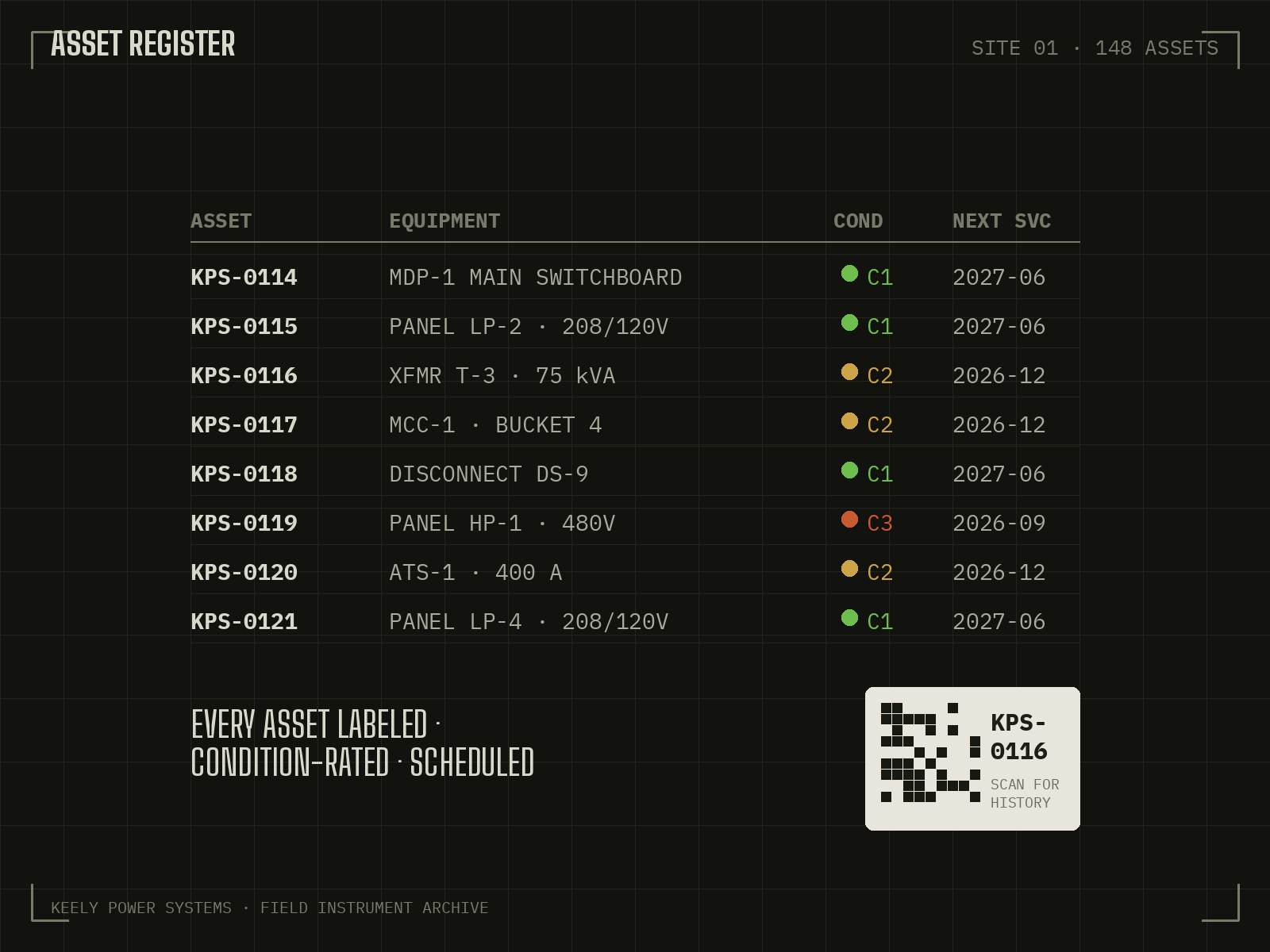
Ask most facility managers for a complete list of their electrical distribution equipment and its condition, and the honest answer is a shrug — drawings are decades old, labels are missing, and institutional memory retired two managers ago. Yet that list is the foundation of every maintenance decision, every budget, and NFPA 70B's required Electrical Maintenance Program.
We build it for you. Every panel, breaker, transformer, disconnect, and motor control is identified, labeled, photographed, and rated for condition and criticality. From there, maintenance intervals and testing scopes practically write themselves — and your program documentation is audit-ready from day one.
Energized testing — infrared, ultrasound, power monitoring — happens while your facility runs and finds problems by their symptoms: heat, sound, and electrical signature. De-energized testing happens during a planned shutdown and measures the equipment itself: insulation resistance, contact resistance, torque, and mechanical operation. A complete program uses both.
Less than most facilities fear. Work is scoped per-section so we test in planned windows — nights, weekends, or holiday shutdowns — and your system is inspected, tested, and back online on a schedule agreed in advance.
Arcing, tracking, and corona each produce distinctive high-frequency sound before they produce visible damage. With enclosed switchgear, ultrasound often detects a developing fault that a thermal camera can't see through the enclosure — which is why the two are used together.
Because everything else builds on it. NFPA 70B's Electrical Maintenance Program starts with knowing what equipment you have and what condition it's in; maintenance intervals, testing scope, and budgeting all flow from that list. Most facilities are surprised by how much undocumented gear the first survey finds.
Yes. Ground resistance and bonding verification confirm that the path protecting your people and equipment actually performs — a frequent weak point in older facilities and a standard part of a full testing program.
Start with a no-cost, no-obligation survey: we'll walk your electrical system, give you a written proposal for your testing program, and include the replacement cost of your electrical distribution — so you know exactly what's at stake.