Your electricians shouldn't have to guess what's behind a panel cover. We calculate the hazard, label the equipment, and give your safety program the data NFPA 70E requires.
An arc flash is an electrical explosion — temperatures hotter than the surface of the sun, molten metal, and a pressure wave, all released in a fraction of a second. The severity at any given panel isn't guesswork; it's physics, determined by available fault current and how fast the upstream protective device clears the fault.
An arc flash study models exactly that for every piece of equipment in your facility. We gather field data, build or verify your one-line diagrams, run short-circuit and protective device coordination calculations, and produce incident energy values for each location. The result: equipment labeled with the real hazard level, working distance, and required PPE — so qualified workers can make safe decisions and your electrical safety program stands on defensible engineering.
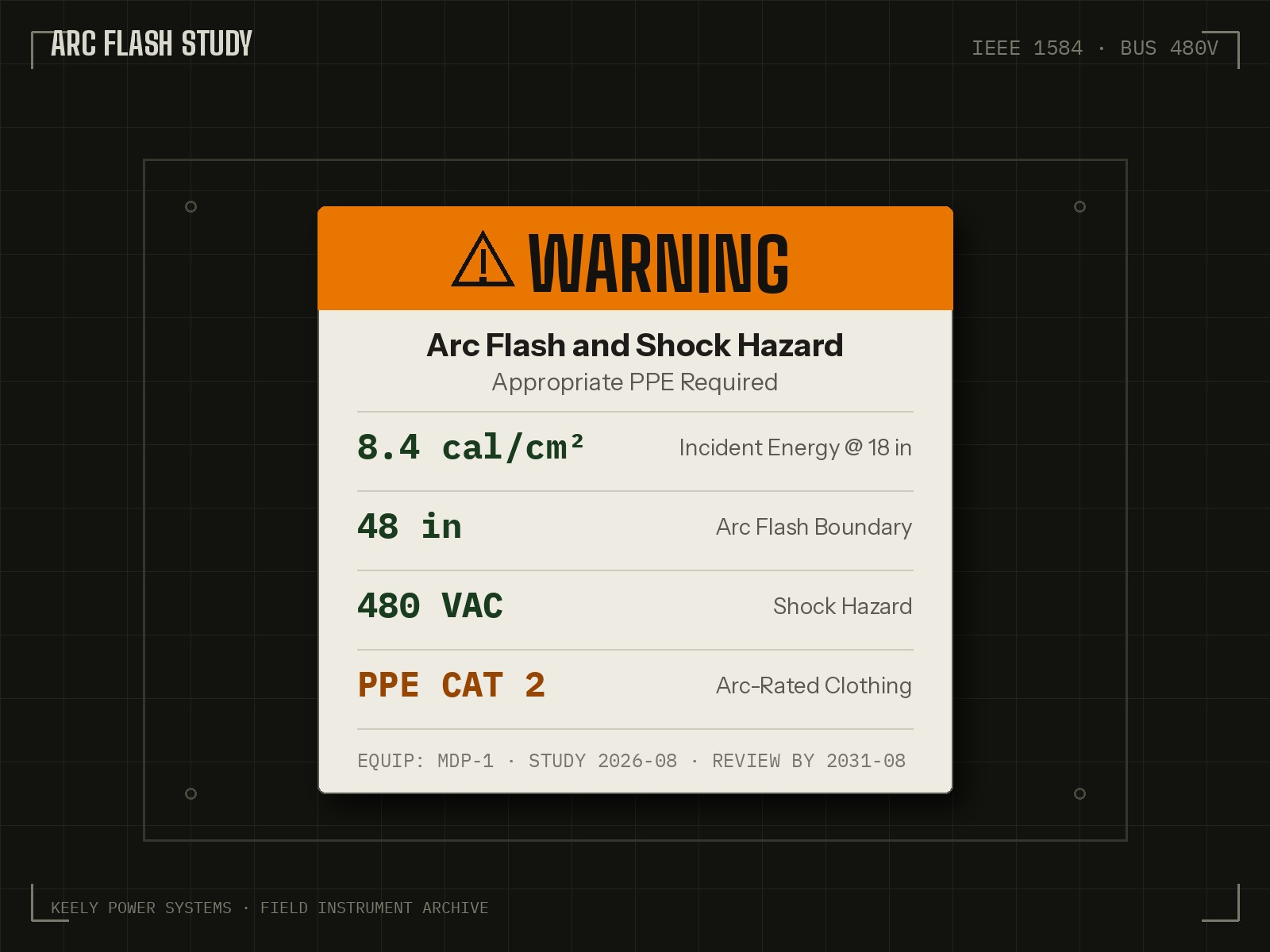
If your gear carries no labels — or generic orange stickers with no incident energy values — your workers and any outside electrician are working without required hazard information.
NFPA 70E caps the review interval at five years. Studies older than that are due even if nothing has changed — and something almost always has.
New equipment, a service upgrade, utility changes, added solar or generation, or swapped breakers all change fault current and clearing times — which changes the hazard on the label.
Safety audits, insurance reviews, and large customers increasingly ask for current arc flash documentation. We deliver studies and labels that stand up to that scrutiny.
Plenty of firms will mail you a study. As an electrical contractor, we also fix what the study finds — coordination problems, mislabeled gear, and maintenance issues that make real-world hazards worse than the calculations assume.
Incident energy math assumes your breakers actually work. Our TEGG maintenance program keeps protective devices tested and trustworthy — so the label on the wall matches reality.
An engineering analysis of your electrical system that calculates the incident energy — the thermal energy a worker would be exposed to — at each piece of equipment if an arcing fault occurred. The results determine arc flash boundaries and what PPE is required, and they're printed on the warning labels applied to your equipment.
NFPA 70E requires equipment likely to be examined or worked on while energized to be field-marked with arc flash hazard information, and OSHA expects employers to assess and communicate electrical hazards. Unlabeled or generically-labeled gear is one of the most common findings in safety audits.
NFPA 70E requires the incident energy analysis to be reviewed when the electrical system changes and at intervals not to exceed five years. If your facility has added equipment, changed utility service, or modified protective devices, the labels on the wall may no longer be true.
Accurate one-line diagrams are the foundation of the study. If yours are outdated or missing — very common — we field-verify and rebuild them as part of the project, which leaves you with current drawings as a deliverable in their own right.
Directly. Incident energy calculations assume protective devices open as fast as their specifications say. A breaker that hasn't been maintained may operate slowly or not at all, making the real hazard higher than the label. That's why NFPA 70E ties safe work to the 'condition of maintenance' — and why studies and maintenance belong together.
Start with a no-cost, no-obligation survey: we'll walk your electrical system, give you a written proposal for your testing program, and include the replacement cost of your electrical distribution — so you know exactly what's at stake.